
Toronto mayoral candidates fail Torontonians
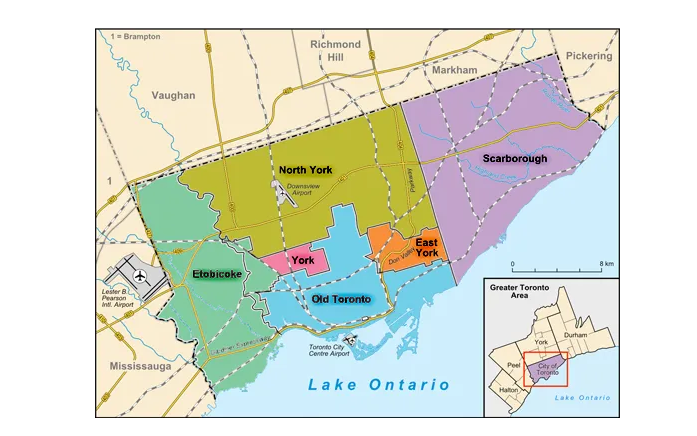

The forced amalgamation of Metropolitan Toronto in 1998 remains a critical focal point for critics who argue that the creation of the "megacity" fundamentally damaged the local governance of Canada’s largest urban centre. Critics of the consolidation contend that merging the former municipalities of Toronto, North York, Etobicoke, Scarborough, York, and East York replaced distinct, responsive local representation with a centralized bureaucracy ill-equipped to address localized crises. From this perspective, the city's modern struggles with housing, transit, and long-term planning are direct consequences of a structural mismatch between diverse communities and a single, sweeping municipal administration.
The following article explores the arguments surrounding the impact of amalgamation, the comparison between historic civic leadership and modern mayoral campaigns, and the debate over de-amalgamation.
The Megacity Experiment: A Legacy of Centralization
When the Ontario government under Premier Mike Harris implemented amalgamation in 1998, the stated goal was to streamline services, eliminate bureaucratic duplication, and reduce costs. However, critics argue that instead of generating efficiency, the consolidation created a sprawling governance structure that diluted local democracy.
Under the pre-1998 two-tiered system, local mayors and councillors managed localized needs like neighbourhood zoning, community centres, and distinct suburban or urban priorities, while Metropolitan Toronto oversaw regional infrastructure. Detractors argue that flattening this system into a single megacity forced vastly different communities—from the dense urban core of old Toronto to the low-density, car-oriented suburbs of Scarborough and Etobicoke—to compete for the same pool of resources under a one-size-fits-all policy framework.
Connecting Amalgamation to Current Urban Crises
Those who view amalgamation as a failure point to several persistent municipal challenges as evidence of structural dysfunction:
- The Homelessness and Housing Crisis: Critics contend that a centralized City Hall struggles to deploy social services effectively across expansive and varied geographies. Suburban areas often face a shortage of localized shelter space and support services, while the downtown core bears a disproportionate share of the burden. Opponents argue that individual borough councils would be better positioned to approve and fast-track localized transitional housing solutions tailored to their specific neighbourhoods.
- Transit and Gridlock: The merging of distinct political regions transformed transit planning into an ideological battleground between urban and suburban voters. For decades, debates over subways versus light-rail transit (LRT) in Scarborough or bike lanes in Etobicoke have stalled major projects. Critics assert that separate municipal governments could plan and fund transit networks that serve their specific ridership demographics without being paralyzed by city-wide political gridlock.
- A Lack of Unified Vision: Amalgamation required a single mayor to represent nearly three million people with deeply conflicting priorities. Opponents argue this structural reality makes it nearly impossible to form a cohesive vision for the city. Instead of policy innovation, municipal governance often shifts between suburban-backed fiscal conservatism and urban-backed progressive spending, leaving long-term planning fragmented.
From Civic Champions to Modern Campaign Rhetoric
A central critique of the megacity era is the perceived decline in the distinct character of Toronto's political leadership. Nostalgia often centers on pre-amalgamation figures like David Crombie, who served as Mayor of Toronto from 1972 to 1978. Known as the "Tiny Perfect Mayor," Crombie's tenure was defined by community-first urban planning, halting massive expressway projects that threatened historic neighbourhoods, and pioneering the mixed-income housing model of the St. Lawrence neighbourhood.
Commentators who argue that amalgamation failed Torontonians contrast the localized, vision-driven leadership of the Crombie era with modern mayoral races. They argue that the sheer scale of a megacity campaign—requiring millions of dollars to reach voters across hundreds of square kilometres—has shifted the political landscape. In this view, modern mayoral candidates are incentivized to rely on broad, focus-tested rhetoric and expensive media campaigns tailored to corporate donors and technocratic management rather than grassroots community advocacy.
The Case for Breaking Up the Megacity
The proposed remedy for these systemic issues is a complete reversal of the 1998 consolidation: dismantling the megacity and restoring independence to the six former municipalities:
- Toronto
- North York
- Etobicoke
- Scarborough
- York
- East York
Proponents of de-amalgamation argue that returning to individual cities and boroughs would restore localized accountability. Each region would elect its own mayor and council, ensuring that political leaders are deeply connected to the distinct needs of their communities rather than managing a massive municipal corporation.
While defenders of amalgamation point out that a single city possesses greater economic leverage, a unified credit rating, and streamlined regional coordination, critics maintain that the human cost—measured in degraded services, political polarization, and a lack of local accountability—outweighs the fiscal arguments. For those who view the 1998 experiment as a misstep, breaking up the megacity remains the most direct path to restoring authentic civic leadership to Toronto's diverse neighbourhoods.

Comments
There are 0 comments on this post