
The Richmond Hill Mayoral Race: Where Concrete Dreams, High-Tension Wires, and Chainsaws Meet
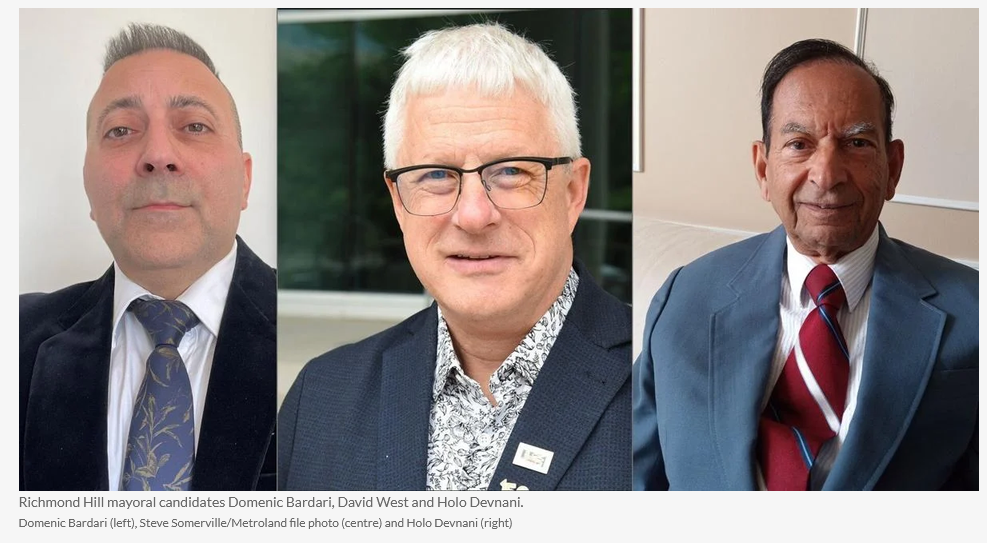

RICHMOND HILL -- With online voting officially underway as of October 20, 2026, and the final Voting Day set for October 26, Richmond Hill residents are preparing to choose who will steer the municipal ship for the next four years. The mayoral ballot features three contenders ready to take on the chaos: incumbent David West, alongside challengers Domenic Bardari and Holo Devnani.
While the race officially centers on tax burdens and infrastructure deficits, underneath the polished rhetoric sits the defining hallmark of York Region governance: Richmond Hill’s long-standing tradition of giving real estate developers carte blanche to pave over the biosphere. If you happen to be a tree in Richmond Hill right now, you are practically sweating sap.
The 407 Corridor: Where Retail Sprawl Meets 500,000 Volts
If you want to understand the soul of Richmond Hill’s land-use planning, you do not look at a municipal mission statement. You look at the Yonge Street and Highway 407 junction.
Nothing speaks to the triumph of unchecked land development quite like the majestic sight of strip malls, fast-food pads, and asphalt parking lots brazenly sprawling directly beneath buzzing, high-tension hydro wires. In most world-class jurisdictions, massive utility corridors flanked by an expressway serve as green buffers or linear parkways. In Richmond Hill, developers looked up at hundreds of thousands of crackling volts dangling from steel transmission towers and thought: "This would be the ideal place for a nail salon, a dry cleaner, and thirty lanes of idling traffic."
It is a poetic monument to the municipality's real estate addiction, only amplified by the lingering shadow of the 407 itself—Ontario’s undisputed champion of botched, privatized infrastructure deals. Between the toll highway overhead and the crackling hydro grid directly below, the city successfully engineered an ecosystem where shoppers can pick up bubble tea while basking in an electromagnetic hum. For decades, hyper-intensified sprawl has treated the town's greenery as an administrative oversight. Trees have watched local planning meetings turn into mere rubber-stamping ceremonies, where builders treat canopy-protection fines as nothing more than a pre-budgeted line item.
Legislative Records vs. Outsider Platforms
When evaluating who can actually steer this ship toward socially progressive change, voters face a stark contrast—largely because David West is the only candidate on the ballot with an actual legislative track record. As a veteran councillor and mayor since 2022, West's voting history is a matter of public record. In contrast, challengers Bardari and Devnani are private citizens pitching agendas from outside city hall.
The deep dive into past council decisions and the candidates’ latest platform responses to the Richmond Hill Liberal reveals distinct philosophies on housing and social policy:
1. David West: The Institutionalist Ledger
Incumbent Mayor David West represents the traditional choice for voters prioritizing a modern, socially progressive change agenda—leveraging an active municipal record explicitly targeting housing equity, environmental protection, and public health programming. Because he has spent years at the council table, his policy positions are written into the city’s actual legislative framework:
- The Housing Accelerator Record: Under West’s administration, Richmond Hill unlocked a $31-million federal Housing Accelerator Fund (HAF) grant. West voted to implement Official Plan Amendment (OPA) 58, which expanded missing-middle density by allowing up to four self-contained dwelling units on standard residential lots. He also oversaw the late 2024 passage of OPA 59, facilitating mid-rise, four-storey developments along priority transit corridors like Yonge Street.
- Financial Incentives for Affordable Rentals: In November 2024, West’s council approved the city's first Community Improvement Plan (CIP) for Affordable Housing and Sustainable Design. This program established direct financial incentives for developers who build sustainably designed, affordable rental housing units.
- Non-Profit Housing Partnerships: West has heavily utilized upper-tier partnerships, highlighting a 2024 regional allocation of $6.6 million to Richmond Hill Ecumenical Homes. This project, breaking ground in 2026, is legally locked to deliver 90 new intensification units, 37 of which are strictly designated as affordable housing.
- Social & Public Health Programming: West's Official 2026 Platform explicitly commits to expanding city-funded local social programs, diversity, equity, and inclusion (DEI) frameworks, and youth empowerment initiatives.
2. Holo Devnani: The Technocratic Macro-Economist
Because Holo Devnani has never held elected office, he has no municipal voting record to defend. His platform approaches social issues not through local safety nets, but through macro-economic and engineering principles:
- The Federal/Provincial Housing Argument: In his October 2026 candidate statements, Devnani argued that municipal affordable housing tools are largely an illusion. He maintains that affordable housing is an "extremely complex" issue driven by federal monetary policies and real wages failing to track home prices.
- Harmonizing and Expediting Approvals: To lower housing costs, Devnani’s platform rejects local architectural micromanagement. He noted instances where homes approved in Markham were rejected in Richmond Hill, forcing expensive redesigns passed onto consumers. His housing plan centers entirely on harmonizing municipal standards and eliminating city hall bottlenecks to lower developer overhead.
- The Social Cost of Zero-Base Budgeting: On broader social policy, Devnani’s primary platform plank is a zero-base budgeting framework. Progressive critics note that requiring every social program and non-profit grant to justify its utility from a $0 baseline every single year often leads to austerity measures that choke vulnerable community services.
3. Domenic Bardari: The Populist Fiscal Conservative
As a retired municipal employee with 35 years of experience within city hall, Domenic Bardari also lacks a legislative voting record but offers a distinct, locally focused alternative. His platform leans heavily into traditional fiscal conservatism with a targeted social focus:
- Pushing Purpose-Built Rentals: In his recent policy answers, Bardari slammed the status quo, stating that "Richmond Hill families are being priced out." Rather than broad systemic housing strategies, Bardari’s platform pledges to actively fast-track missing-middle housing approvals and specifically drive purpose-built rentals over luxury condos.
- Targeted Social Support for Seniors: Bardari's primary socially minded platform piece focuses on an aging demographic. He advocates for expanding practical, city-level supports to allow seniors to age in place safely within their homes and communities.
- Neighborhood Safety Committees: Beyond targeted support for seniors, Bardari’s social policy heavily emphasizes community policing and safety, proposing direct resident-led Community Safety and Crime Committees to handle local security concerns.
Regional Overlords and the Strong-Chair Shadow
To make things even more precarious for the local canopy and local social initiatives, the next mayor must walk into York Region headquarters to confront a multi-billion-dollar infrastructure and social services funding deficit. Compounding that headache is the provincial government's deployment of "strong-chair" regional powers, designed to bulldoze municipal pushback and accelerate housing targets.
In practical terms, even if Richmond Hill’s council were to collectively throw their bodies in front of a bulldozer to protect a park or demand a deeper affordable housing allocation, a provincially designated regional chair can effectively sweep the local objection aside and clear the lot for another mega-block anyway.
The Final Tally
As the campaign enters its home stretch, local advocacy groups are holding civic workshops at the Richmond Hill Public Library in a bid to overcome legendary voter turnout fatigue.
The next four-year term officially begins on November 15, 2026. Whether voters opt for West’s cautious containment and established legislative ledger, Devnani’s high-voltage server farms, or Bardari’s council-rese
Comments
There are 0 comments on this post