
Elon Musk dumps MAGA after midterm blowout, feels 'foolish' bank rolling failed GOP candidates
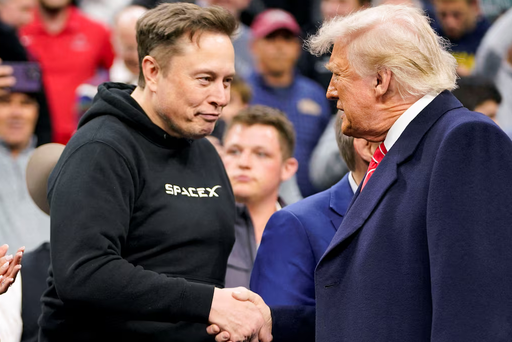

In a display of political buyer’s remorse so blindingly bright it can practically be seen from low Earth orbit, the world’s richest man has officially abandoned the sinking ship he spent nearly half a billion dollars to construct. Speaking via livestream from Shenzhen, China—while, in a stroke of peak comedic irony, travelling alongside President Donald Trump for the APEC summit—Elon Musk sat down for a 46-minute interview with columnist Andrew Ross Sorkin at the New York Times DealBook Summit to announce he is quitting the movement he spent two years meme-ing, subsidizing, and algorithmically force-feeding to the public.
“I'm not MAGA,” Musk declared, suddenly developing acute amnesia regarding the "Dark Gothic MAGA" persona he paraded across campaign stages. During the DealBook conversation, Musk lectured voters on the dangers of political tribalism—comparing party loyalty to blindly rooting for a hometown sports team—and suddenly discovered the virtues of a divided government rather than single-party rule. Having poured roughly $474 million into GOP campaigns only to watch Republicans get swept out of both chambers of Congress, Musk admitted his quest for a Republican Senate majority "failed" and left him feeling "pretty foolish about having spent so much money and not seeing much for it". Even more awkwardly for his former allies, Musk abruptly softened his tone toward the opposition, praising incoming Democratic Texas Governor Gina Hinojosa as a pragmatic moderate whose leadership would keep business in the Lone Star State "fine." Turns out, buying a political party doesn't work quite like buying a social media platform—you can't just fire the voters when the engagement metrics tank.
Subsidizing Inflation and Imperialist Misadventures
It wasn't exactly a mystery why everyday Americans declined to reward Musk’s half-billion-dollar vanity project at the ballot box. Musk’s massive bankroll went straight toward propping up an administration whose signature domestic achievement was making groceries and gas unaffordable, largely thanks to launching an unpopular, budget-torching war with Iran eight months before Election Day.
While working families were getting mugged at the gas pump, Musk was busy playing budget-slasher from the comfort of his private jet. Even Vice President JD Vance admitted the Iranian quagmire was a political albatross, though Trump—true to form—told 60 Minutes that the historic shellacking was entirely the fault of disliked GOP candidates and mean journalists.
From "Drain the Swamp" to a "Colossal Cesspool"
Beyond the economic pain, the administration managed to pull off a feat of ideological alchemy: becoming the exact shadowy cabal they spent years railing against. When Donald Trump first ran for president, his signature rallying cry was a promise to "drain the swamp" and dismantle the entrenched "Deep State." Instead, as Steven Greenhouse documented in The Guardian, Trump didn't drain the swamp—he gilded it and turned Washington into a "colossal cesspool" of pay-to-play access, billionaire sycophants, and brazen conflicts of interest.
Look at every classic stereotype of what the "Deep State" is supposed to be: an unaccountable shadow network operating in secrecy, enriching insiders through backroom favours, ignoring the will of the voters, and bypassing Congress and the Constitution to wage foreign conflicts. Through open self-dealing—including firing over 15 independent inspectors general to dodge oversight, selling presidential pardons to major donors, and launching unilateral military escalation abroad—Trump didn't defeat the Deep State. He governed just like the secret, corrupt group he always warned voters about, acting like an unhinged strongman inside the very swamp he promised to clean up.
Even the war with Iran became a family profit centre. As The Guardian detailed, Trump’s sons Don Jr. and Eric invested in a drone maker courting Gulf states under Iranian attack, while the Pentagon handed a $24 million contract to a robotics firm where Eric serves as "chief strategy adviser" and son-in-law Jared Kushner sought billions from Saudi Arabia while acting as a Middle East envoy. Former President Barack Obama captured that exact dynamic on the midterm campaign trail, delivering blistering critiques of how the White House had been turned into a personal cash register. Speaking to rallies in Michigan and Ohio, as documented on his Medium page, Obama noted that Americans had "lost count of all the deals he and his family have done"—pointing to crypto meme coins, foreign payouts, and taxpayer-funded contracts flowing directly to Trump’s sons and family businesses while the president and his family added roughly $4 billion to their wealth in office. Obama warned that this single-minded pursuit of power and profit—paired with what he called a "weak commitment" to the rule of law, an independent judiciary, and basic democratic values—looked less like American constitutional governance and more like the behaviour of self-enriching dictators abroad.
Right at the centre of that unaccountable machine sat Musk himself, operating as an unelected billionaire wrecking ball taking an axe to public institutions while his own company, SpaceX, kept raking in billions in federal contracts. By underwriting an authoritarian agenda that bypassed democratic guardrails, Musk ensured his historical footnote won’t just be his net worth—it will be serving as the chief venture capitalist for an anti-democratic project that American voters overwhelmingly threw in the trash.
Burning $420 Billion in Shareholder Value
That catastrophic political miscalculation didn't just incinerate campaign cash; it detonated shareholder value. For years, Wall Street treated Musk as an untouchable oracle of capital allocation, willing to forgive missed deadlines and erratic tweets under the assumption that his genius always paid off. That myth evaporated the morning after the ballots were counted, as institutional investors scrambled to price in a Democratic Congress armed with subpoena power and zero patience for cozy regulatory favours.
Within forty-eight hours, Tesla shares and SpaceX secondary valuations plunged, wiping out over $420 billion in combined market capitalization and vaporizing roughly $113 billion of Musk’s personal fortune. By turning himself into the partisan mascot of a deeply unpopular regime, Musk successfully transformed sleek electric vehicles into rolling MAGA hats, alienating the exact eco-conscious consumers who built his empire.
It begs an obvious question for any institutional investor still holding the bag: how can anyone trust the financial judgment of a billionaire who casually lights nearly $500 million on fire betting on obvious political losers? While regular investors are lectured on fiduciary duty and risk management, Musk ignored basic polling, economic reality, and common sense just to feel like one of the cool kids at a rally.
South Park Called It: The Curse of "Billionaire Weenietown"
Long before the midterm ballots were cast, pop culture had already diagnosed the exact pathology driving Musk’s public unravelling. In South Park’s biting Season 29 episode, “Billionaire Weenietown,” creators Trey Parker and Matt Stone skewered a "new strain" of attention-starved tech oligarchs who violate the golden rule of quiet wealth. In the episode, traditional old-money elites try to teach these insecure newcomers "proper billionaire etiquette"—staying out of the spotlight, avoiding endless podcast appearances, and refraining from hijacking public discourse until regular citizens demand an exterminator.
Musk’s political faceplant is a live-action validation of that satire. Rather than quietly lobbying behind closed doors like classic industrialists, Musk craved the roar of the crowd and the dopamine hit of viral memes. By stapling his personal brand to Donald Trump’s forehead, he guaranteed that Trump’s electoral humiliation would become his own.
The Conservative Media Exodus
Musk is hardly the only prominent figure scrambling for the lifeboats now that the ship is taking on water. Across the right-wing media ecosystem, influencers who spent months carrying water for the administration are suddenly discovering their independent streaks.
Conservative podcaster Brett Cooper announced she was severing ties with MAGA altogether, telling the Financial Times that "there was a lot of gaslighting that took place" regarding the Jeffrey Epstein files, the Iran conflict, and worsening economic distress. Meanwhile, Joe Rogan—whose 2024 endorsement helped pave Trump's road back to the White House—surveyed the wreckage on his podcast, admitting as reported by USA Today that Republicans "didn't just lose the podcast bros. They lost most of the country".
A Legacy Written in Red Ink
As The Guardian noted following his DealBook remarks, Musk is now attempting a hasty rebrand as a pragmatic centrist who sees "positives and negatives in both parties." Unfortunately for him, the internet has receipts—and they are denominated in nine figures. History won't remember Elon Musk merely as the richest man on Earth, but as the oligarch who gambled half a billion dollars to bankroll authoritarianism and foreign wars, only to discover that American democracy isn't for sale—and even $500 million can't buy a clue.

Comments
There are 0 comments on this post