
America’s broken social contract: Why Trump’s post-midterm defiance makes the unthinkable worth debating


In any functioning constitutional democracy, the periodic verdict of the ballot box is meant to act as a corrective mechanism. When voters deliver a sweeping rebuke to the party in power, the system relies on an unwritten compact: the executive branch absorbs the message, recalibrates its priorities, and governs with a renewed awareness of the broader public will. The presidency, uniquely among American institutions, is designed to represent the entirety of the republic—not merely a partisan faction, a personal movement, or an ideological vanguard.
Yet the events following the 2026 United States midterm elections suggest that this foundational assumption has collapsed. Confronted with decisive Republican losses across both chambers of Congress, President Donald Trump did not pivot toward the political centre or seek common ground with a newly empowered opposition. Instead, after briefly acknowledging the results on election night, he reverted to questioning the integrity of the vote, boasted of his constitutional veto power as a weapon to force Democratic compliance, and dismissed his former chief of staff, Susie Wiles—widely viewed as one of the few remaining pragmatic guardrails inside the West Wing—in favour of Stephen Miller, the hardline architect of his administration’s most polarizing policies.
To dismiss this sequence of events as mere political hardball is to miss its deeper constitutional significance. Taken together, the administration’s post-midterm posture raises a question once confined to the fringes of American political thought, yet now increasingly unavoidable: if the federal executive refuses to honour the democratic mandate of the electorate, what remains of the social contract binding the American states together?
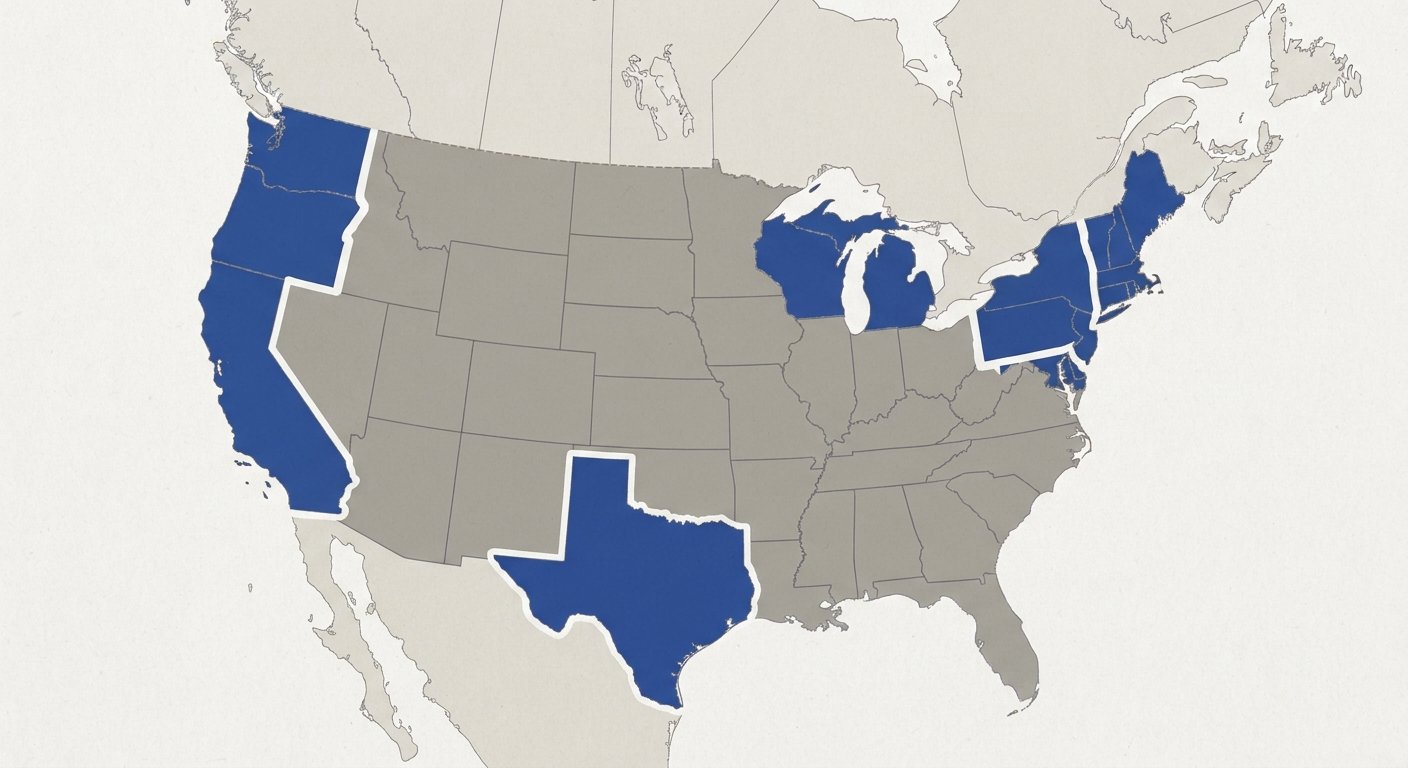
For citizens in states that voted decisively for a change of direction—from New England to the Great Lakes, and even within changing corners of the American South and Southwest—the answer is sobering. Under the current constitutional architecture, a president armed with the veto pen and insulated from further electoral accountability can effectively paralyze legislative reform for the remainder of his term. When that power is wielded not in service of a more perfect union, but in defiance of the electorate’s expressed will, the conversation inevitably shifts from policy reform to constitutional legitimacy—and, ultimately, to whether peaceful separation or realignment is no longer taboo, but a rational subject of democratic debate.
The anatomy of a democratic repudiation
To understand the gravity of this moment, one must begin with the clarity of the voters’ message. Midterm elections are routinely described as referendums on a sitting president, and in the autumn of 2026, Mr. Trump explicitly invited that framing. Throughout the campaign, he urged voters to cast their ballots as though his own name were at the top of the ticket, staking his political capital on an agenda defined by punitive tariffs, aggressive immigration raids, and an escalating military conflict with Iran that sent energy prices surging across North America.
The electorate’s response was unambiguous. Democrats reclaimed control of both the House of Representatives and the Senate, propelled by voters frustrated by rising household costs, endless foreign entanglements, and the heavy-handed exercise of executive authority. In states such as Michigan, Maine, and across key congressional battlegrounds, voters rejected candidates closely aligned with the White House’s trajectory. Even in traditionally conservative strongholds like Texas, shifting demographics and economic anxieties produced fierce contests that underscored the breadth of public dissatisfaction.
In the immediate aftermath of the vote, there were fleeting hints of conventional statesmanship. Speaking on election night, Mr. Trump remarked that he was willing to accept the outcome and suggested he would find ways to work with the incoming Democratic majorities. Within days, however, that posture evaporated. By the following Monday, the President was once again casting doubt on the honesty of the election on social media, asking how the polls could have been so wrong—a familiar rhetorical move designed to delegitimize any electoral outcome unfavourable to him.
More consequential than his rhetoric, however, were his personnel and strategic decisions. Rather than interpreting the loss of Congress as a signal to moderate, Mr. Trump declared his intention to rely on his veto power until Democrats capitulated to his demands. And by elevating Stephen Miller to White House chief of staff, he sent an unmistakable message to Capitol Hill and the country at large: there would be no course correction.
For more than a decade, Mr. Miller has stood at the centre of the administration’s most uncompromising initiatives, from family separations at the southern border to mass deportation campaigns and sweeping executive assertions of power. Replacing Ms. Wiles—a seasoned political operative credited with imposing a measure of discipline on the West Wing—with an ideological loyalist signals that the final two years of the presidency will be governed not by consensus-building, but by executive unilateralism.
The limits of constitutional remedies
Apologists for the current system will argue that gridlock is an intentional feature of the American design, not a flaw. The framers of the U.S. Constitution deliberately constructed a system of checks and balances—bicameralism, staggered elections, the executive veto, and judicial review—to prevent transient majorities from enacting sweeping changes too quickly. Patience, the argument goes, is the price of stability; voters who dislike the president’s actions need only wait until the next presidential election in 2028.
That argument rests on a premise that no longer holds: that all branches of government operate in good faith within shared democratic norms.
The constitutional veto was conceived as a defensive shield to protect the executive branch from legislative encroachment or to pause ill-considered bills. It was never intended to serve as an instrument of indefinite minority rule by a president who openly questions the legitimacy of elections and treats the office as an extension of personal will. When a chief executive signals that he will block any legislation reflecting the newly elected Congress unless his own agenda is advanced, the constitutional balance tips from healthy friction into institutional paralysis.
Consider what this means for the millions of Americans who went to the polls seeking tangible relief from economic strain, foreign military entanglement, and divisive domestic policies. Under the existing framework, their votes have yielded representation in the legislature, yet zero prospect of translating that representation into law. A Democratic Congress can hold hearings, issue subpoenas, and pass bills addressing healthcare, housing affordability, trade policy, or war powers, only to watch them die on the Resolute Desk. Because overriding a presidential veto requires a two-thirds supermajority in both chambers—a threshold virtually unattainable in an era of deep partisan polarization—the president effectively exercises an absolute check on democratic governance.
Nor does the federal judiciary offer a reliable refuge. Reshaped over successive appointment cycles into a deeply conservative body, the Supreme Court has increasingly deferred to expansive theories of executive authority while curtailing the regulatory reach of federal agencies. For states and citizens seeking policy outcomes aligned with the post-midterm majority, every institutional avenue within Washington appears sealed shut.
The social contract and the Declaration’s logic
It is precisely at such moments of institutional impasse that political philosophy ceases to be an academic exercise and becomes a practical guide. The United States was not founded as an indivisible blood-and-soil empire; it was constituted as a voluntary union of states bound by a social contract.
That principle is articulated most clearly in the Declaration of Independence. Written to justify the dissolution of political bands that had become destructive of the ends for which government is instituted, the Declaration rests on a straightforward proposition: governments derive their just powers from the consent of the governed. When a governing authority ceases to represent the public good, systematically disregards the petitions and electoral verdicts of its citizens, and subordinates the common welfare to self-serving ends, the people retain the right—indeed, the duty—to alter or abolish it.
Critics routinely invoke the memory of the American Civil War to shut down any discussion of state separation, equating all talk of dissolution with the Confederacy’s defence of slavery. That historical analogy is both intellectually lazy and morally inverted. The secession of 1861 was an armed insurrection launched to preserve human bondage and subvert a democratic election. What is being contemplated by frustrated citizens today is the precise opposite: a peaceful, legal reassessment of a constitutional compact that no longer delivers democratic representation or a "more perfect Union."
In modern constitutional democracies, the question of self-determination and territorial realignment need not be settled by force of arms. Canada itself offers a striking precedent. Through the Supreme Court of Canada’s landmark 1998 Reference re Secession of Quebec and the subsequent Clarity Act, Canadians established a legal and democratic framework acknowledging that a clear majority vote on a clear question obligates the federation to negotiate terms of separation in good faith. Similarly, the United Kingdom’s 2014 referendum on Scottish independence demonstrated that mature democracies can debate the boundaries of political union peacefully at the ballot box.
The United States lacks an explicit secession clause in its 1787 Constitution, and the post-Civil War precedent of Texas v. White declared unilateral secession unconstitutional. Yet constitutional law is not a suicide pact, nor is it immutable. The Constitution itself provides mechanisms for amendment and structural reorganization, and legal scholars have long noted that bilateral or negotiated separation—or the formation of interstate compacts and regional autonomy arrangements—could be pursued through constitutional convention or mutual legislative consent if the political will existed.
A continental realignment: State-nations and the Canadian question
If the current federal arrangement in Washington remains locked in permanent dysfunction, what forms might a peaceful reconfiguration take? Looking across the map of North America, three distinct pathways emerge—each rooted in geographic, economic, and cultural realities that already transcend outdated 18th-century boundaries.
First is the emergence of autonomous "state-nations." Several American states already possess populations, economies, and institutional capacities rivaling those of independent European nations. Texas, with an economy larger than that of Canada or Italy, has long harboured a distinct political identity and energy infrastructure capable of sustaining self-governance. While its political culture differs markedly from that of the Northeast, Texans across the political spectrum share a deep skepticism of distant federal micromanagement. Were Texas to pursue genuine sovereignty or a looser confederal status, it would possess the demographic and economic scale to stand on its own.
Second is the formation of regional federations among neighbouring states with shared values and integrated economies. In New England, states such as Maine and Vermont—joined potentially by Massachusetts, New Hampshire, Connecticut, and Rhode Island—share deep historical ties, compatible social policies, and interconnected energy and transportation grids. Rather than remaining hostage to electoral college math or presidential vetoes dictated by distant regions, a New England compact could govern itself in accordance with the democratic preferences of its residents, prioritizing public healthcare, environmental stewardship, and pragmatic trade relationships.
Third—and most intriguing from a Canadian perspective—is the prospect of northern border states seeking closer political union or outright accession to Canada.
Consider the geography and cultural affinity of states such as Vermont, Maine, and Michigan. Vermont’s ties to Quebec and eastern Ontario are woven into its daily life, from cross-border commerce to shared environmental stewardship of the Lake Champlain basin. Maine’s economy and heritage are deeply intertwined with New Brunswick and Atlantic Canada, sharing timberlands, fisheries, and coastal communities that often feel closer to Halifax or Montreal than to Washington. Michigan, situated at the heart of the Great Lakes, shares not only a vital industrial supply chain with Ontario—exemplified by the Windsor-Detroit corridor—but also a common stake in the preservation of the world’s largest freshwater system.
For residents of these border states, looking north reveals a parliamentary democracy that, for all its own partisan debates, remains committed to universal healthcare, gun safety, multilateral diplomacy, and a social safety net that reflects the aspirations many northern Americans voted for in November. Conversely, for Canada, the peaceful addition of industrious, resource-rich, and culturally compatible states—or the creation of a deeper North American common market and associate-state framework—would dramatically expand its demographic weight, economic resilience, and strategic reach.
The cost of clinging to an illusion
None of these scenarios would be simple to execute. Negotiating the division of national debt, currency arrangements, military assets, and citizenship rights would require years of painstaking diplomacy and legal ingenuity. Skeptics will rightly point out that the administrative hurdles alone are daunting, and that millions of Americans remain deeply attached to the symbols and history of the United States.
Yet the alternative—continuing to pretend that a fractured, hyper-polarized federation can function indefinitely under a president who rejects electoral accountability—carries its own profound risks.
When citizens lose faith that their ballots can produce meaningful change, cynicism curdles into alienation. A political system that demands obedience to federal authority while denying the electorate the fruits of its democratic choices is living on borrowed time. By appointing Stephen Miller and brandishing the veto pen in the wake of a historic midterm defeat, Donald Trump has inadvertently clarified the stakes for every American state.
The United States was built on the radical idea that political structures exist to serve the people, not the other way around. If Washington refuses to honour the verdict of the governed, then Americans—from the forests of Maine and the shores of Michigan to the plains of Texas—owe it to themselves to ask whether the pursuit of a more perfect union now requires charting a new course altogether.

Comments
There are 0 comments on this post