
Trump uses France to inspire the ghost of Hitler
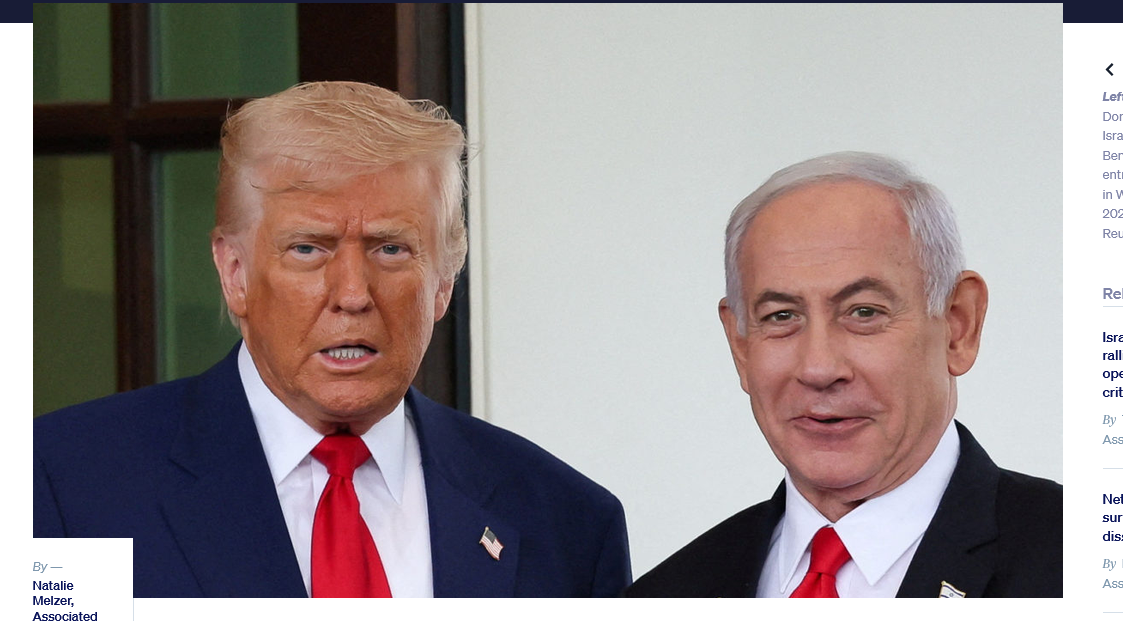

Donald Trump’s aggressive attacks on "communists" borrow directly from Adolf Hitler's playbook in a way that should deeply alarm every American. Far from an outdated rhetorical quirk, this language is a calculated effort to legitimize a catastrophic move toward martial law within the United States. We see the physical reality of this strategy starting to take shape, most recently highlighted by a heavy-handed, paramilitary Immigration and Customs Enforcement (ICE) raid on a Somali American family's home. By mixing raw racism with systemic fear, Trump is building a dangerous framework to subvert American democracy from within.
In politics, the resurrection of a ghost is rarely about the ghost itself; it is about what that ghost can be used to justify. When Trump floods the political arena with Cold War-era vitriol—denouncing mainstream Democrats, progressive critics, and community advocates as "godless communists" bent on destroying the American way of life—dismissing the language as a bizarre anachronism misses a deeply chilling historical reality. Trump’s insistence on labeling domestic opponents as a "cancer" or an "enemy from within," combined with a hyper-militarized approach to federal law enforcement, provides a dangerous blueprint for dismantling democratic norms.
The Strategy of "Anti-Communism Without Communism"
The core of this authoritarian strategy rests on creating a climate of "anti-communism without communism." For a demagogue, the label of "communist" is highly effective precisely because it functions as an all-encompassing, diabolical catch-all. In his public addresses, Trump has starkly demonstrated this by expanding the definition of the enemy to include almost any domestic adversary, declaring at various points that the political left is made up of illegal immigrants, criminals, radicals, and institutional subversives. By fusing economic leftists, undocumented immigrants, civil servants, and the unemployed into a singular, undifferentiated threat, the rhetoric converts a complex web of modern societal issues into a simple, demonic plot.
This is the exact strategy that paved Adolf Hitler’s path to absolute power in the early 1930s. Long before the horrors of the death camps, Hitler galvanized ordinary citizens by tapping into their intense economic anxieties, post-World War I grievances, and social fractures. He pointed to a manufactured existential threat: the Marxist and Jewish "subversive." In the Weimar Republic, the Nazi party did not win over the public by immediately proposing totalitarian control; they won by positioning themselves as the ultimate bulwark against a fictional, catastrophic communist takeover.
When the Reichstag building burned in February 1933, Hitler did not pause for an investigation or allow due process to take its course. He immediately blamed a communist conspiracy, asserting that a "murderous pest" had to be crushed with an iron fist to save the nation from collapse. That manufactured crisis allowed him to pressure President Paul von Hindenburg into signing the Reichstag Fire Decree. This single piece of legislation permanently suspended civil liberties, eliminated freedom of the press, criminalized political dissent, and authorized the federal government to take over state governments. The imaginary communist threat was the key that unlocked the door to a one-party dictatorship.
Weaponizing Foreign Crisis: The False Narrative of the French Riots
Like Hitler, Trump relies heavily on creating anger against racial and religious scapegoats. We see this happening right now on the global stage. Trump is pointing to the widespread, chaotic protests and riots in France—which actually started over student grievances and the high cost of living—and falsely claiming at recent rallies that the European nation has been "conquered, looted, and burned to the ground by migrants, jihadists, and communists." This is pure deception designed to trigger racial fear in American voters.
By twisting the reality of the French unrest, Trump creates a terrifying, fictional mirror for American voters. He warns his crowds that if they do not grant him absolute authority, American cities will face the same imaginary foreign invasion. This exploitation of international news serves a specific psychological purpose: it makes the domestic audience believe that Western civilization is under a coordinated, global assault from racial and ideological outsiders.
The true causes of the French protests—economic inequality, corporate greed, and reduced public services—are completely erased from Trump's narrative. In their place, he inserts a racist caricature of a continent collapsing under the weight of non-white immigration. By framing the situation in France as a race war driven by leftist subversion, Trump prepares his base to accept extraordinary, illegal measures at home to prevent a similar fictional collapse.
Economic Sabotage: The Real Roots of Market Instability
This calculated domestic fear strategy directly connects to the chaos Trump is creating globally. His ongoing war against Iran and his aggressive global tariff wars are deeply destabilizing financial markets. Working families are paying the price through soaring energy and fuel costs. Yet, instead of fixing the economic damage caused by his own reckless policies, Trump uses his rallies to blame a fictional alliance of immigrants, leftists, and foreigners for the world's problems.
The economic reality is stark. By tearing up international agreements, threatening military strikes against Iran, and imposing sweeping tariffs on both allies and adversaries, Trump has disrupted global supply chains. These actions have triggered severe market volatility, caused inflation to spike, and sent oil and gas prices skyrocketing. Instead of taking responsibility for the direct consequences of his volatile foreign policy, Trump uses the resulting financial pain as political ammunition.
This mirrors the classic fascist technique of economic misdirection. When inflation or unemployment rises due to executive incompetence, the autocrat does not alter their economic strategy; they amplify their hatred toward vulnerable groups. Trump tells struggling working-class Americans that their financial hardships are not caused by his corporate tax cuts or chaotic trade policies, but by the "immigrant invasion" and "communist saboteurs." This redirects legitimate economic anger away from the government and toward minority communities, turning shared financial pain into racial resentment.
ICE and the Modern Paramilitary Apparatus
The weaponization of language inevitably demands a weaponized apparatus to enforce it. The recent paramilitary raiding of a Somali American's home serves as a terrifying case study in how existing federal agencies can be distorted into tools of political intimidation. When ICE conducts high-profile, heavily armed operations within domestic civilian spaces, it serves a dual purpose: it enforces an administrative policy while simultaneously conditioning the public to accept a permanent state of emergency and hyper-militarization.
Trump's frequent declarations that he will invoke the Alien Enemies Act of 1798—a law historically used during wartime to bypass judicial review and deport foreign nationals without due process—and deploy military assets on American soil are no longer speculative. They are blueprints for a selective form of martial law. Under this framework, targeted demographics can be stripped of their basic legal rights under the guise of an ongoing national emergency.
To understand the systemic danger of this trajectory, one must look to how the Nazi regime reshaped law enforcement in its infancy. Long before the Schutzstaffel (SS) became a sprawling, bureaucratic empire of industrial terror, the early Hitler regime relied on the rapid expansion, politicization, and normalization of existing police forces and party paramilitary wings, such as the Sturmabteilung (SA).
The historical parallel between that transformation and the modern utilization of federal enforcement agencies unfolds across three distinct structural strategies:
- The Erasure of Citizen-Noncitizen Boundaries: The raid on a Somali American home underscores a terrifying sociological truth: in a hyper-politicized enforcement climate, the line between immigrant and citizen rapidly evaporates. In the early days of the Weimar Republic's collapse, the Nazis initially targeted "Eastern European Jewish immigrants" under the pretext of economic preservation, public safety, and anti-communism. However, the specialized police task forces, surveillance mechanisms, and legal exceptions created to hunt these foreigners were seamlessly turned against naturalized citizens, political dissidents, and eventually all German citizens who opposed the regime. Once a federal enforcement agency is trained, incentivized, and culturally conditioned to ignore constitutional boundaries for one group of people, it possesses the capability—and the muscle memory—to ignore them for anyone.
- The Normalization of Paramilitary Force in Civil Life: By utilizing tactical military gear, dynamic forced entries, armored vehicles, and overwhelming physical intimidation for routine administrative or immigration enforcement, agencies like ICE are gradually pushed into the role of a domestic political militia. This mirrors the early 1930s Nazi tactic of integrating traditional civil police forces with ideological paramilitaries. The goal of the Third Reich was to ensure that law enforcement answered not to local magistrates, independent courts, or the civil constitution, but directly to the executive’s ideological whims. When civil law enforcement begins to look, act, and think like an occupying army, the psychological distance between a free democracy and a police state disappears.
- Manufacturing the Necessity for Martial Law: Authoritarianism fundamentally requires a visible, chaotic enemy to justify the suspension of civil liberties to the broader public. By staging high-visibility, terrifying raids against specific diaspora communities, the state actively manufactures a sense of crisis. It creates the optical illusion of an out-of-control, dangerous internal threat that normal laws cannot contain. Just as Hitler used the myth of an imminent, widespread communist uprising to justify the permanent suspension of habeas corpus, modern authoritarian rhetoric frames immigrant and minority communities as an invading, criminal force. The playbook uses these aggressive enforcement actions to generate the very social friction and visual chaos that the executive can later claim only military intervention and full martial law can fix.
The Erosion from Within
The United States possesses robust constitutional barriers, a long history of institutional checks and balances, an independent press, and a resilient legal system. It is not Weimar Germany. Yet history provides a stark, unwavering reminder that democracies rarely fall to sudden, external conquests. Instead, they erode from within when their institutions are systematically hollowed out, and when their citizens become gradually desensitized to the language and mechanics of autocracy.
When a political movement resurrects the red-scare playbook and deploys militarized agents into neighborhoods, it is not engaging in a standard debate over economic theory or border security. It is conditioning the public to accept the weaponization of the state against its own people. It is a deliberate test of the nation's legal, moral, and psychological boundaries.
If the American public normalizes the idea that political opposition is a form of treason, and that federal agencies can operate as ideological blunt-force instruments, it is handing a would-be dictator the matches to our own democratic institutions. The laughter at the historical absurdity of hunting for "communists" in the 21st century must stop. The transition from targeted immigration raids to full-scale martial law will not require a sudden, violent coup—it will simply be the next logical step in a playbook that humanity has seen before, with catastrophic results. The danger it signals is deadly serious, and the time to recognize the pattern is before the trap springs shut.

Comments
There are 0 comments on this post