
The Mississauga Mayoral Race: Where the Frontrunners Stand on the City's Biggest Issues
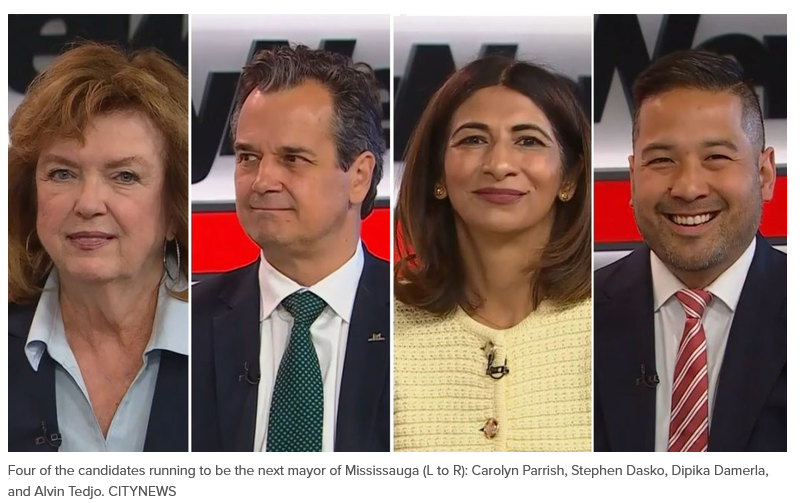

MISSISSAUGA - With voters heading to the polls on October 26, 2026, the race for Mississauga’s top job has evolved into a highly competitive municipal battle. What began as a 15-year political rivalry between the city’s current and former mayors has expanded into a tight multi-candidate race. Recent polling from Liaison Strategies shows a statistical dead heat among decided voters, with former mayor Bonnie Crombie at 30 per cent, current incumbent Carolyn Parrish at 29 per cent, and Ward 2 councillor Alvin Tedjo surging to 26 per cent. Ward 7 councillor Dipika Damerla remains a vocal force in the four-candidate frontrunning pack.
As the candidates wrap up their final debates, the spotlight remains firmly fixed on Mississauga's fiscal future, infrastructure deficits, transit plans, and public safety. Here is how the four frontrunners plan to handle the city's most critical issues.
Property Taxes and Fiscal Management
Faced with a mounting $1.2-billion infrastructure deficit, the candidates have put forward sharply contrasting visions for managing the city’s budget and property tax rates.
- Alvin Tedjo has positioned himself as the candidate of radical change by pledging a two-year property tax freeze. While opponents have dismissed the plan as an unfeasible election stunt, Tedjo maintains it is a necessary measure to provide immediate relief to residents struggling with the high cost of living.
- Bonnie Crombie is taking a more traditional fiscal approach, promising to cap property tax increases at or below the rate of inflation. She points to her tenure as a three-term mayor to assure voters she can balance infrastructural growth with taxpayer affordability.
- Dipika Damerla strongly opposes any tax freezes, arguing they would trigger reckless budget shortfalls down the road. Instead, Damerla proposes the immediate hiring of an independent auditor general to systematically root out municipal waste and lower costs naturally.
- Carolyn Parrish has defended the tax increases implemented during her two years in office, noting that municipal spikes have been heavily tethered to mandatory regional obligations, specifically the rising costs of the regional police budget.
Policing and Crime
Public safety and police funding have sparked some of the most aggressive exchanges of the campaign trail. The Peel Regional Police budget has spiked by over 80 per cent since 2021, turning police accountability into a major election talking point.
- Carolyn Parrish drew significant criticism from her fellow council members after her decision to quit the Peel Police Services Board. Parrish defended her exit, while her opponents have framed the move as an abdication of leadership during a time of heightened anxiety over local crime.
- Alvin Tedjo has leveraged his platform to secure a historic endorsement from the local police union, highlighting his commitment to collaborating directly with law enforcement to address neighborhood crime while keeping long-term regional expenses under control.
- Dipika Damerla focuses her strategy on rebalancing how the city pays into the regional system. She argues that auditing and restructuring the Peel police funding formula will unlock much-needed cash flow for city-specific infrastructure without compromising local safety.
- Bonnie Crombie continues to press Parrish on her board resignation, promising a return to active municipal oversight and steady council representation on regional safety boards.
Transit and Economic Development
Gridlock and growth remain central priorities as Mississauga grapples with provincially mandated housing targets and a rapidly growing population.
- Bonnie Crombie has made transportation the centerpiece of her economic platform, aggressively campaigning on a pledge to build Mississauga’s first subway line connecting the city directly to Toronto. On the economic front, Crombie has proposed a municipal "tariff action team" to proactively protect local business interests.
- Alvin Tedjo and Dipika Damerla have directed their economic focus toward fostering localized industry. Both councillors advocate for aggressive municipal investments into tech startups, innovation hubs, and manufacturing supports to ensure Mississauga residents can work within their own borders rather than commuting into neighboring hubs.
- Carolyn Parrish emphasizes finishing the long-term infrastructure overhauls currently underway across the city’s major arteries, asserting that her experience navigating city hall is crucial to steering these massive capital projects to completion without further driving up municipal debt.
The Final Stretch
The tone of the race shifted dramatically in its closing days. Following weeks of fiery, deeply personal attacks—including a heated dispute regarding Parrish’s absence from early debate stages—the candidates struck a notably more cooperative tone during their final debate at First United Church in Port Credit.
With the frontrunners separated by only a few percentage points, the final outcome will likely hinge on voter turnout. Historically, municipal turnout in Mississauga has hovered under 26 per cent. Whether this highly contentious, star-studded rematch between Mississauga's past and present leaders will successfully drive a disillusioned electorate to the ballot box remains to be seen when the final votes are cast on October 26.
Comments
There are 0 comments on this post