
Why Iceland’s future lies in Carney’s Canada, not a fractured Europe
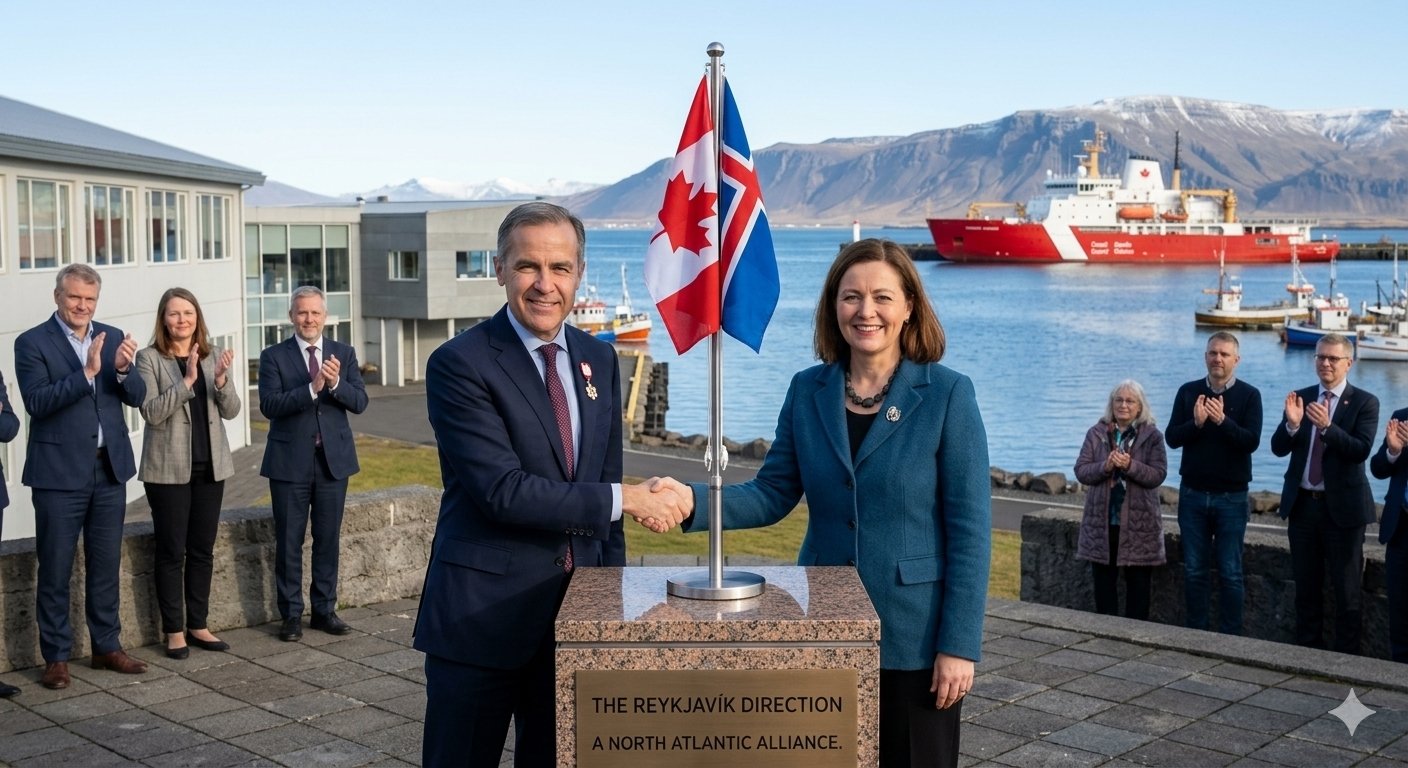

REYKJAVÍK — There is a growing feeling among many Icelanders that the old ways of looking at the map are changing. For the past thirty years, Iceland has walked a careful line: doing business closely with Europe through the European Economic Area (EEA), while keeping a firm hold on its independence and its rich fishing grounds. But lately, that old deal is starting to feel a bit tight.
Europe is dealing with a lot of its own problems right now. Between political gridlock in major capitals like Paris and Berlin, and a mountain of new rules coming out of Brussels, the European Union is looking more inward than ever. For a small nation of 390,000 people, trying to navigate this complicated European landscape is becoming harder, costlier, and less rewarding.
But as Icelanders look around for better options, a very familiar neighbour across the water is waving back.
Canada is stepping up its game in the North. Under Prime Minister Mark Carney, Canada is focusing heavily on protecting the Arctic, building strong trade networks, and working with trusted friends. As climate change opens up new shipping routes in our shared backyard, Canada and Iceland are finding themselves standing at the exact same front door.
What if Iceland’s best future isn’t found in the crowded, complicated markets of Europe, but in a fresh partnership across the Atlantic?
Canada offers Iceland a brilliant alternative. It gives you the economic muscle, security, and stability of a G7 country, but without the heavy-handed rules that make full EU membership so unpopular in Reykjavík. Best of all, Canada has zero interest in telling Iceland how to manage its own oceans and natural resources.
While a close Canadian-Icelandic alliance might sound like a wild new idea, the truth is that the two nations have been flirting with this exact plan for years—especially when things got tough.
I. The Ghost in the Transatlantic Corridor
To see where this idea comes from, we have to look back to the 2008–2011 Icelandic financial crisis. When the country’s main banks collapsed under a mountain of bad debt, the local currency—the króna—lost its value almost overnight. Suddenly, buying simple things from abroad became incredibly expensive. In the middle of that panic, a group of everyday Icelandic citizens started a campaign called "Invite Iceland In."
Their idea was bold: they officially suggested that Iceland should join Canada as its 11th province.
While joining Canada as a province was mostly a creative dream, it sparked a much more serious debate that reached the highest levels of government. People started asking: What if Iceland dropped the króna and adopted the Canadian dollar instead?
The logic was simple. The Canadian dollar—often called the "loonie"—is a steady, reliable currency backed by a massive resource economy. Adopting it would give Icelanders instant financial safety without forcing them to join the Euro or hand over control of their laws to the European Union. The idea became so popular that then-Prime Minister Jóhanna Sigurðardóttir had to speak publicly about it.
Fast forward to today, and that old conversation is back, but for a different reason. Iceland’s economy is stable now, but the global trading system is changing fast. For everyday families living in Reykjavík, Akureyri, or the Westman Islands, the question of who you partner with isn’t just about big politics. It is about how much a basket of groceries costs at Bónus or Krónan, and whether your home mortgage interest rates are going to skyrocket next month.
II. Why the European Deal is Frustrating Everyday Life
For decades, Icelanders have relied on the EEA agreement to sell fish to Europe and travel freely. It seemed like a good compromise because it kept Iceland out of the EU’s Common Fisheries Policy, which would force Iceland to share its fishing quotas with massive European fleets.
But Brussels has changed. Today, the EU passes an endless stream of strict regulations that don’t fit Iceland’s needs. For a small society, just trying to read, translate, and enforce thousands of pages of European bureaucracy has become an exhausting chore.
More importantly, this relationship hits the pockets of everyday Icelanders. Because Iceland is tied closely to Europe’s trade block, it faces high tariffs on food and goods imported from outside Europe. This is a major reason why supermarket prices in Iceland are some of the highest in the world.
Canada offers a totally different approach. Canada is a vast country that understands what it means to live, work, and harvest resources in a cold climate. Ottawa does not want to control Iceland’s oceans. A direct trade deal with Canada would mean bringing cheap, high-quality Canadian agriculture, grain, and consumer goods straight into Icelandic stores without the heavy European taxes. It means making the weekly grocery bill genuinely affordable.
III. The Simple Math of Using the Canadian Dollar
Let’s talk about how changing to the Canadian dollar would actually work, and how it would change daily life for an Icelandic family. Swapping your currency without joining a country is called "dollarization." It sounds complicated, but the mechanics are quite straightforward.
1. Out with the Króna, In with the Loonie
The Central Bank of Iceland would use its existing foreign reserves to buy back all the krónas in circulation. Over a set transition period, your bank accounts, your salary, your grocery prices, and your bills would simply be rewritten in Canadian dollars. The króna would disappear, and you would start using the exact same cash and digital money used from Vancouver to Toronto.
2. Bringing Peace of Mind to Mortgages
If you ask any Icelandic homeowner what causes them the most stress, the answer is almost always mortgage stability. Because the Icelandic króna is a tiny currency in a massive global ocean, it gets pushed around easily by international markets. To protect the economy, the Central Bank of Iceland often has to raise interest rates to painful levels. This makes home loans unpredictable and expensive.
By switching to the Canadian dollar, Iceland would instantly inherit the steady, low-inflation environment of a major global power. Your mortgage rates would become predictable. Families would no longer have to worry that a global market shift halfway across the world will suddenly double their monthly housing payments.
3. A Currency That Fits the Way You Work
If Iceland adopted the Euro, it would be using a currency designed for industrial manufacturing giants like Germany. But Iceland doesn't build millions of cars; it exports fish, aluminum, and tourism. Canada’s economy is built exactly like Iceland’s—on nature, energy, and weather. When global commodity prices move, the Canadian dollar adjusts in a way that matches Iceland's economic heartbeat perfectly.
IV. Mark Carney: A Leader Who Speaks Your Language
The argument for looking toward Canada gets a huge boost because of the person running the government in Ottawa. Prime Minister Mark Carney is a globally respected financial expert who understands exactly how to build stable economies.
Carney isn't a typical smooth-talking politician. He is a numbers guy who previously ran the Bank of Canada and the Bank of England. He is famous for helping Canada sail through the 2008 global financial crisis without a single bank failing. He knows the plumbing of the global financial system inside and out. If Iceland ever wanted to transition its economy to a safer currency structure, Carney is the ultimate ally to help design the blueprint and ensure global markets respect the move.
Under his leadership, Canada has passed new initiatives like the One Canadian Economy Act, which focuses on making life more affordable and building strong connections with trusted democratic allies. Carney’s style is pragmatic, transparent, and focused on clear results—values that match perfectly with the direct, honest way Icelanders like to do business.
V. Peaceful Neighbours: Cooperating in the Arctic
When we talk about northern security, we don’t need to talk about warships, heavy weapons, or military posturing. For Canada and Iceland, security has always been about peaceful cooperation, safety, and protecting a fragile environment.
As climate change thaws the ice up north, the Arctic is becoming a busy highway for global shipping. This brings real challenges: Who will rescue a stranded cruise ship? Who cleans up an oil spill in freezing waters? Who ensures that foreign mega-corporations respect environmental laws?
By working together, Canada and Iceland can build a model for peaceful Arctic management. Canada has immense resources, icebreakers, and satellite technology. Iceland has the perfect location and unparallelled local knowledge of the North Atlantic. Together, they can create a premier search-and-rescue network, share advanced marine climate science, and ensure that the North remains a peaceful, low-tension zone dedicated to cooperation rather than conflict.
VI. Shared Values: A Natural Cultural Fit
Ultimately, the best reason for Iceland to look west instead of east comes down to core human values. Icelanders take immense pride in their progressive, fair, and open society. You care deeply about gender equality, human rights, strong social safety nets, and protecting the environment.
These are the exact pillars that define the Canadian identity. Canada is a diverse, welcoming democracy that believes society is stronger when neighbours look out for one another. Unlike the hyper-competitive, often cutthroat political environment seen in parts of Europe and the United States, Canada offers a gentle, community-minded approach to the modern world.
Canada is also home to the largest community of Icelandic descendants outside the home country—the "Western Icelanders" who settled in places like Manitoba over a century ago. This means the cultural connection is already alive and well.
For a long time, Icelanders have felt stuck with a difficult choice: join the EU and lose your independence, or stay out in the cold alone. Mark Carney's Canada offers a warm, sensible third path. It gives Iceland the safety, cheap goods, and mortgage stability of a global superpower, while fully respecting your independence and your values. The North Atlantic is opening up, and it is time for Iceland and Canada to step through the front door together.

Comments
There are 0 comments on this post