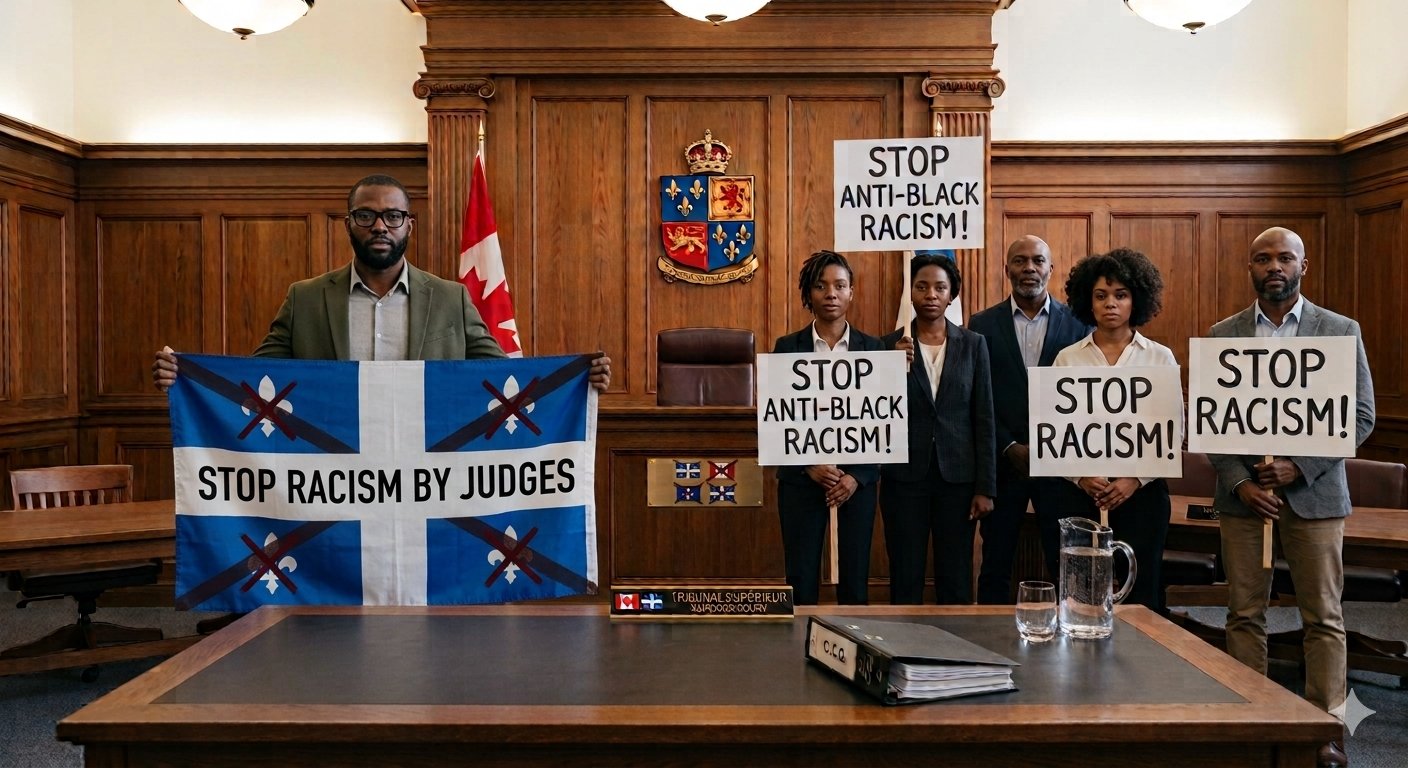
The Hon. Justice Catherine Piché Must Resign to Restore Integrity to the Quebec Superior Court
Severe allegations have been raised regarding a decision attributed to Justice Catherine Piché,
asserting that the court relied on false premises regarding a
litigant’s university credentials to issue a vexatious litigant order.
Critics argue that fabricating or misrepresenting facts to humiliate a
human rights claimant—especially one backed by a Government of Quebec
agency—constitutes an abuse of power that undermines the very purpose of
judicial immunity. From this perspective, rewriting judicial findings
to sustain what is perceived as egregious systemic bias or racism should
disqualify any sitting judge from the bench, as vexatious litigant
designations are meant to protect court resources, not shield
institutions or police forces from legitimate, state-endorsed civil
rights complaints brought by Black litigants.
The Core Allegation: Fabricating Premises for Humiliation
At
the heart of the demand for Justice Piché’s immediate resignation is a
deeply troubling assertion regarding a recent judicial proceeding.
Critics and court observers state that Justice Piché actively weaponized
the power of her office by relying on false premises regarding a
litigant’s university credentials. According to these accounts, the
court falsely claimed the litigant lacked a university diploma, using
this fabricated narrative as the primary justification to systematically
humiliate a human rights claimant.
What
makes this action profoundly despicable is the identity and backing of
the victim. The claimant in question was pursuing a civil rights action
actively endorsed by a Government of Quebec agency. For a federally
appointed judge to construct an alternate reality from the
bench—specifically designed to diminish the academic standing and
personal credibility of a marginalized citizen—is a subversion of the
rule of law. It represents an intolerable abuse of authority that strips
the court of its moral authority.
A Disqualifying Pattern of Systemic Bias
The
weaponization of a litigant's personal background cannot be viewed in
isolation. Analysts argue that the efforts to rewrite judicial history
and tailor decisions to fit a preconceived outcome point directly to
egregious systemic bias and racism. When a member of the judiciary
shapes facts to justify the dismissal of a civil rights claim, they are
no longer practicing law; they are engaging in a calculated political
prosecution.
+------------------------------------+---------------------------------------------------------+

| Proper Use of Vexatious Orders     | Alleged Weaponization by the Bench                      |
+------------------------------------+---------------------------------------------------------+

| Preserves finite judicial resources| Shields institutions and police from public scrutiny     |
| Restricts bad-faith legal abuse    | Punishes Black litigants pursuing civil rights cases    |
| Maintains institutional neutrality | Executes political reprisals against valid complaints  |
+------------------------------------+---------------------------------------------------------+
Writers
and legal advocates argue that these actions completely disqualify
Justice Piché from holding office. The public cannot be expected to
respect the decrees of a court where decisions are allegedly moulded to
preserve systemic inequalities. To allow this to pass without
consequence signals to the broader public that the judiciary is a closed
shop designed to protect state actors from the very laws they are sworn
to enforce.
The Perversion of Vexatious Litigant Orders
Vexatious
litigant orders exist in Canadian common and civil law for a singular,
noble reason: to protect the administration of justice from authentic
abuse, harassment, and bad-faith actors who swamp the docket with
frivolous claims. They were never intended to act as a legal fortress
for racist judges to subject Black people to political prosecution and
administrative reprisal.
In
this instance, the issuance of the vexatious designation is viewed by
critics as a shield erected on behalf of a municipal police force facing
a government-endorsed racial profiling complaint. By branding the
victim "vexatious" under false pretenses, the court effectively
insulated the police from accountability and cancelled a legitimate
$44,000 human rights claim. Using the ultimate procedural death penalty
to silence a Black citizen who stood up to state abuse is a grotesque
perversion of the system. It turns a mechanism of court protection into a
weapon of racialized suppression.
A Necessary Overhaul of Judicial Immunity
This
controversy forces a necessary, long-overdue review of the doctrine of
judicial immunity. While judges must be free to make difficult decisions
without fear of personal liability, immunity was never crafted to serve
as a license for malicious falsehoods or systemic discrimination. When a
judge allegedly fabricates facts to fulfill a political or racialized
agenda, the protective cocoon of immunity must be questioned.
To
restore public confidence in the Superior Court of Québec, Justice
Catherine Piché must resign immediately. If she refuses, the Canadian
Judicial Council must step in, initiate a transparent, thorough
investigation, and recommend her removal to Parliament. Anything less
confirms that in the eyes of the law, the protection of a compromised
bench matters more than the constitutional rights of the citizens it is
meant to serve.