
The Silent Annexation: Why Greenland must turn to Canada to save its sovereignty

I. The Illusion of the Danish Shield
For generations, the political architecture of the North Atlantic has rested on a comfortable, if increasingly hollow, premise: that the Kingdom of Denmark would serve as an immutable shield for Greenland’s sovereignty. In Nuuk, successive coalition governments have calibrated their slow, deliberate marches toward ultimate independence under the assumption that Copenhagen would guard the gates of foreign policy and defence while we built our domestic institutions.
That comforting illusion has shattered. We have entered an era of raw geopolitical transaction, driven by a resurgent and unvarnished American expansionism. Washington’s long-standing obsession with the world’s largest island has transformed from standard diplomatic pressure into an explicit, coercive campaign to integrate Greenland into the American political-industrial complex.
The structural failure of the Danish state to protect Greenlandic interests is no longer a matter of theoretical debate. Denmark’s recent capitulations prove that putting faith in the Danish Prime Minister to protect Greenlandic sovereignty is a dangerous mistake. Faced with overwhelming economic, military, and diplomatic pressure from the United States, Copenhagen has consistently chosen to protect its standing within the European Union and NATO at the direct expense of Greenland’s self-determination.
If Greenland does not act decisively to alter its geopolitical trajectory, it risks losing its future entirely in a secret, backroom deal brokered over our heads. To escape permanent vassalage to a superpower intent on exploiting our vast critical mineral reserves and strategic geography, Greenland must demand an immediate national referendum with an option to become a Canadian territory.
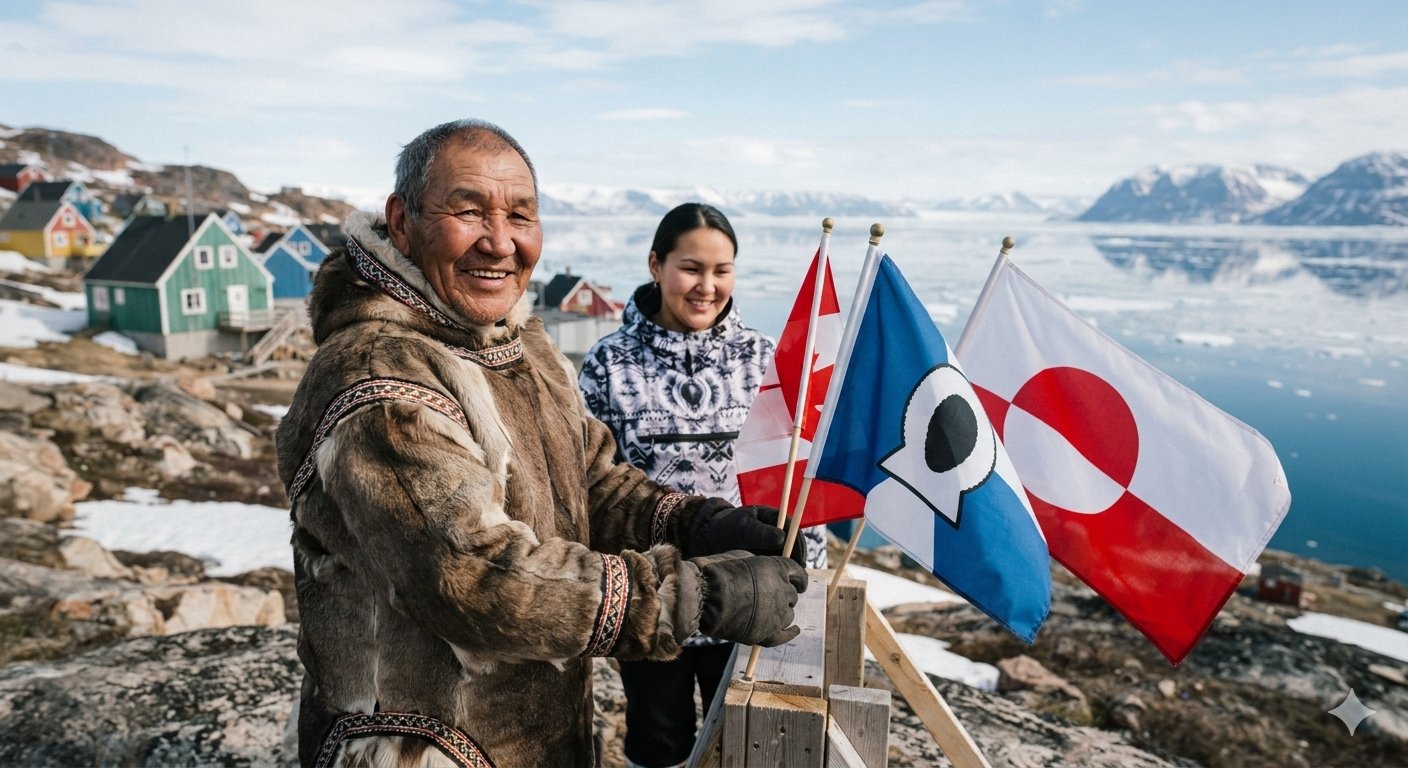
This is not an abandonment of the independence movement; it is its salvation. Aligning with Ottawa offers a legally protected, constitutionally stable path to true Arctic self-determination, modeled after the realization of Nunavut. It is a necessary pivot away from an empire that views us as property, and toward a neighbor that shares our blood, our culture, and our commitment to Indigenous governance.
II. A History of Capitulation: From Thule to the 2026 Security Pact
To understand why Denmark cannot be trusted to defend Nuuk from Washington, one needs only to look at the historical record. Copenhagen’s relationship with Greenland has always been characterized by an asymmetrical colonial dynamic, punctuated by moments where Danish officials quietly traded away Greenlandic land, safety, and human rights to appease American security demands.
The precedent was set during the Cold War. The 1951 Defence Treaty between Denmark and the United States effectively turned Greenland into a military playground for the Pentagon without the consent of the Inuit population. The most egregious manifestation of this agreement was the construction of the Thule Air Base (now Pituffik Space Base). In 1953, the Danish government forcibly relocated entire Inughuit communities from their ancestral hunting grounds in Uummannaq to make way for American bombers and radar installations. For decades, Copenhagen systematically covered up the presence of nuclear weapons on Greenlandic soil, violating its own official nuclear-free policy and exposing Greenlanders to radioactive contamination when a B-52 bomber crashed near Thule in 1968.
This pattern of subjugation is not confined to military infrastructure; it extends to deep structural violations of Greenlandic bodily and cultural autonomy. The recent exposure of the "Spiral Case" (spiralkampagnen) revealed that during the 1960s and 1970s, Danish health authorities forcibly or deceptively fitted thousands of Inuit women and girls—some as young as 12—with intrauterine contraceptive devices to artificially limit the growth of the Greenlandic population. While Danish Prime Minister Mette Frederiksen has issued historical apologies for these programmatic abuses, the fundamental power dynamic remains unchanged: Greenland remains a territory whose ultimate destiny is treated as an external management problem by the Danish state.
The most damning piece of evidence arrived with the announcement of the bilateral security agreement between Washington and Copenhagen. Confronted by explicit economic threats and aggressive posturing from the White House, the Danish government bypassed meaningful oversight from Nuuk to grant the United States unprecedented, irreversible military authority over our island.
While Prime Minister Frederiksen and Greenlandic Prime Minister Jens-Frederik Nielsen attempted to put a brave face on the announcement, claiming the deal formally respects "sovereignty and territorial integrity," the details leaked by senior U.S. State Department officials paint a chilling picture of total submission. The pact grants the American military permanent, unexpiring access, overflight rights, and basing privileges that remain legally binding even if Greenland achieves full independence from Denmark in the future.
Furthermore, the agreement awards Washington an explicit veto over Greenland's economic future. Under the new terms, non-NATO countries are banned from constructing infrastructure on the island, and the United States retains the sole authority to approve or deny any "sensitive investments" in our emerging critical mineral, maritime, and telecommunications sectors. This is not a security partnership; it is a permanent economic and military lockdown designed to transform Greenland into an exclusive resource base for the American industrial core. Denmark signed the document because it had to protect its own continental standing, leaving Greenlanders to bear the cost of American occupation.
III. The American Political-Industrial Complex and the Threat of Exploitation
The urgency of this crisis cannot be overstated. The United States does not view Greenland as a sovereign nation-in-waiting or a distinct cultural community. To the planners in Washington, the Pentagon, and the corporate boardrooms of Wall Street, Greenland is an immense piece of unoccupied real estate sitting atop the world's most valuable cache of unexploited resources.
As climate change accelerates the melting of the Greenland Ice Sheet, previously inaccessible deposits of rare earth elements, neodymium, praseodymium, dysprosium, and copper are becoming exposed. These minerals are the lifeblood of the modern industrial economy, essential for everything from advanced military hardware to the green energy transition. The American political-industrial complex is determined to monopolize these assets to counter Chinese dominance in global supply chains.
The current geopolitical climate has stripped away any pretense of diplomatic subtlety. The White House has made it clear that it views the Arctic through the lens of zero-sum competition. The Pentagon’s decision to redraw its internal command structures, officially shifting Greenland out of European Command (EUCOM) and into Northern Command (NORTHCOM), was the structural prelude to this annexation. By categorizing Greenland as part of the domestic North American defense zone, Washington has signaled that it will no longer tolerate European mediation over our island's security architecture.
Without a powerful constitutional counterweight, Greenland's domestic economy will be completely overwhelmed by American corporate interests. Our regulatory frameworks, designed for a small society of 57,000 people, will be systematically dismantled by multinational mining conglomerates backed by the threat of American military enforcement. Nuuk will find itself trapped in an classic extractive cycle: our mountains will be hollowed out, our pristine fjords will face environmental degradation, and the profits will flow entirely to shareholders in New York and Houston, leaving the Inuit majority with nothing but low-wage service jobs and environmental devastation.
IV. The Trans-Arctic Bond: Reconnecting the Inuit Homeland
To counter this looming tragedy, Greenland must look across the Davis Strait. A geopolitical pivot toward Canada is not an artificial alliance born out of desperation; it is the restoration of an ancient, organic relationship that predates the arrival of European colonizers in the Arctic.
The Inuit of Greenland (Kalaallit) and the Inuit of Canada (including the Inuvialuit, Nunavummiut, Nunavik, and Nunatsiavut) are one people. We share a common ancestry, a deeply linked linguistic heritage, and an identical relationship to the land, the ice, and the sea. The Thule migration, which began in northern Canada nearly a thousand years ago, carried our ancestors eastward across the water to Greenland. For centuries, the ice bridge across the Nares Strait served as a highway for cultural exchange, trade, and familial survival.
This deep cultural connection was artificially severed by European imperial cartography, which drew an arbitrary line down the middle of Baffin Bay, assigning one half of the Inuit homeland to the British Empire (and later Canada) and the other to the Kingdom of Denmark. Despite this separation, the underlying bond has never been extinguished. The creation of the Inuit Circumpolar Council (ICC) demonstrated that our political goals are aligned: we seek the preservation of our language, the defense of our marine ecosystems, and the establishment of self-determination across the Arctic.
By integrating into the Canadian federal structure, Greenland would be reunited with its cultural sister-nation. The political, artistic, and academic exchanges that currently happen on the margins of international conferences would become foundational pillars of a shared domestic policy. Greenlandic Inuit would no longer be a distant, exotic minority managed by an elite political class in a European capital 3,500 kilometers away; we would become an essential part of an empowered, contiguous Arctic Indigenous block within North America.
V. The Nunavut Model: A Blueprint for Sovereignty within Confederation
The primary objection raised by critics in Nuuk will be that moving from the Danish Kingdom to the Canadian Confederation is simply trading one colonial master for another. This argument ignores the profound evolution of Canadian constitutional law over the past fifty years and misunderstands the nature of modern Canadian federalism.
Canada is one of the few nations on earth that has successfully developed a legal and political framework capable of accommodating genuine Indigenous self-governance within a democratic state. The premier example of this is Nunavut, established in 1999 through the largest Indigenous land claims agreement in Canadian history.
If Greenland were to enter Canada as a distinct territory modeled after Nunavut, its autonomy would not be diluted; it would be constitutionally entrenched. Unlike the Danish Self-Government Act of 2009, which exists merely as an act of the parliament in Copenhagen that could theoretically be altered or ignored under international duress, Greenland's rights within Canada would be protected by Section 35 of the Canadian Constitution Act, 1982. This section provides absolute, unalterable protection for Aboriginal and treaty rights, rendering them immune to the whims of shifting federal administrations.
Under a Canadian territorial framework tailored to our specific needs, Greenland would secure:
- Inuit Land Claims and Resource Devolution: Greenland would retain direct ownership of its subsurface mineral rights and offshore fisheries. The devolution process, similar to the historic agreement signed between Ottawa and Nunavut, would guarantee that the royalty streams from critical mineral extraction remain inside Greenland to fund our healthcare, education, and social infrastructure.
- Public Government with an Inuit Majority: Because the demographic reality of Greenland matches that of Nunavut (where over 80 percent of the population is Inuit), a territorial public government would naturally remain under Indigenous control. The Greenlandic language (Kalaallisut) would gain immediate protection under federal law, elevating it alongside English and Inuktitut as an official language of the Arctic north.
- A Sovereign Voice in Continental Defence: As a Canadian territory, Greenland would not be a passive landscape occupied by the Pentagon. It would have a direct seat at the table in the modernization of the North American Aerospace Defence Command (NORAD). Canada’s approach to Arctic security emphasizes community infrastructure and multi-use facilities, ensuring that military radar upgrades also bring deep-water ports, fiber-optic internet, and clean energy grids to our remote settlements.
VI. The Path to the Referendum
We stand at a definitive turning point in Arctic history. The signature of the U.S.-Denmark defense agreement next week at the United Nations General Assembly will mark the beginning of our quiet annexation if we remain passive. We can no longer afford to watch as Copenhagen signs away our geography to insulate itself from the erratic threats of a White House administration.
The Inatsisartut (the Parliament of Greenland) must take immediate, radical action to preserve our national dignity. We must bypass the bilateral negotiations between Copenhagen and Washington and appeal directly to our population. Nuuk must demand an urgent national referendum offering the Greenlandic people a clear, historic choice: to accept permanent American military oversight under the Danish Crown, or to initiate formal negotiations to join the Canadian Confederation as an autonomous territory.
A referendum would fundamentally alter the geopolitical calculations of both Washington and Copenhagen. It would signal to the world that the Inuit of Greenland refuse to be treated as passive currency in a game of great-power politics. It would force Canada—a nation that has historically vacillated on its Arctic responsibilities—to step forward and embrace its destiny as a true Arctic leader, welcoming its eastern brothers and sisters back into a shared constitutional home.
The road to true independence was never going to be easy. But true independence cannot be built on a foundation of American military coercion and Danish diplomatic retreat. By turning our gaze away from the old colonial capital of Europe and looking across the water to Canada, Greenland can protect its land, preserve its culture, and build a secure, autonomous future anchored in the unified strength of the Inuit homeland. The ice is melting, and the world is arriving at our shores. We must choose our destiny before it is chosen for us.

Comments
There are 0 comments on this post