
Gatineau case shows complicity of Quebec's Chief Justice on human and civil rights violations
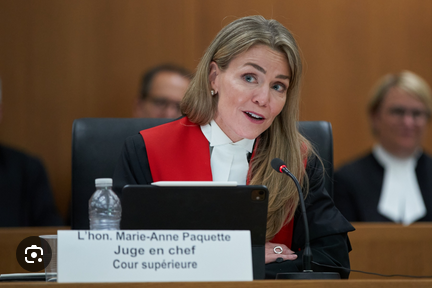

MONTREAL — Serious questions are being raised over judicial integrity and systemic racism within Quebec’s legal framework following explosive allegations involving the province’s highest judicial office and a newly drafted appeal.
A Superior Court judgment rendered on May 28, 2026, has prompted an immediate legal challenge. Raymond Carby-Samuels has prepared an official Notice of Appeal to be filed with the Court of Appeal of Quebec, alleging "Show Trial" conditions and severe violations of the province's primary human rights framework.
A Fight Against Racial Profiling
The long-standing dispute originates from a July 5, 2022, complaint brought before the Tribunal des droits de la personne (TDP), with the Commission des droits de la personne et des droits de la jeunesse (CDPDJ) initially acting on behalf of Carby-Samuels. The CDPDJ endorsed a $44,000 claim against the Ville de Gatineau and several police officers—including Mathieu Brazeau, Guillaume Choquette-Bussière, Jonathan Desjardins, Nicolas Gagnon, and Shawn Mahar—citing severe instances of racial profiling.
However, the legal path for the self-represented visible minority litigant took a sharp turn when the CDPDJ ceased acting in the case in February 2023. While court records initially cited an "impasse", Carby-Samuels' drafted appeal reveals a far more controversial cause for the breakdown. According to the legal documents, the impasse was directly triggered by Gatineau defense counsel subjecting the CDPDJ lawyer to aggressive demands to turn over Carby-Samuels' private Ontario medical records and university transcripts. The appellant contends these materials had absolutely nothing to do with the CDPDJ's profiling investigation, and that the demands flagrantly violated his foundational privacy rights protected under Section 9 of the Quebec Charter of Human Rights and Freedoms.
Following the withdrawal of the commission's counsel, Carby-Samuels continued the proceedings in his own name, persistently demanding his right to understand the proceedings in English under standard constitutional language safeguards.
Allegations of Judicial Collusion and "Double Jeopardy"
The case has drawn sharp criticism toward the current leadership of the Superior Court of Quebec. Carby-Samuels contends that the office of the Chief Justice, The Honourable Marie-Anne Paquette, spearheaded a coordinated, politically motivated effort to label him a "vexatious litigant" to strip away his rights under Section 24(1) of the Canadian Charter of Rights and Freedoms.
Crucially, the upcoming Notice of Appeal argues that the Respondents engaged in improper "judge-shopping" and violated the principles of judicial finality. On April 2, 2025, coordinate judge Justice Azimuddin Hussain explicitly exercised his discretion to deny a formal quarrelsome litigant order, opting instead to issue a warning and close the file. The draft appeal documents argue that launching overlapping vexatious litigant applications immediately afterward in August 2025 constitutes an abuse of process and a de facto violation of Section 37.1 of the Quebec Charter regarding double jeopardy.
While other coordinate judges, such as Justice Brian Urbas on February 24, 2026, met Carby-Samuels and chose not to declare him vexatious, the file was continuously advanced through what the appellant calls an "unlawful" reopening directed by the Chief Justice's office.
Mandatory Judicial Mandate Ignored
The appellant’s drafted Notice of Appeal places significant emphasis on the Statement of Principles on Self-Represented Litigants and the Accused issued by the Canadian Judicial Council (CJC). Carby-Samuels argues that these guidelines are not merely optional suggestions, but form a binding administrative mandate that both judges and court officials must actively uphold.
The legal filings specifically quote the CJC's framework to highlight the standard of care required in high-stakes civil rights cases:
"Judges and court officials alike are mandated to accommodate self-represented parties to prevent an unfair disadvantage, including explaining basic legal implications and discussing procedural options."
According to the draft appeal, the trial court fundamentally flipped this protective mandate upside down. Rather than providing the required accommodations to a self-represented visible minority litigant who had suffered racial profiling, the court inappropriately characterized the innocent inquiries of the appellant as "extremely burdensome and vexatious judicial tactics" in order to support a biased narrative. By explicitly ignoring the CJC's established guidelines, the appellant argues that the court completely stripped away necessary procedural fairness, creating an immediate ground to declare the entire vexatious litigant order a nullity.
An Ideological and Discriminatory Vendetta
The conflict reportable peaked under the May 28, 2026, judgment. In her ruling, The Honourable Catherine Piché granted the application from the defendants' lawyer, Mathieu Daponte, officially declaring Carby-Samuels a vexatious litigant based on a sprawling summary of motions, emails, and appeals.
The draft Notice of Appeal strongly emphasizes that Justice Piché was apparently acting at the direct behest of Chief Justice Anne Paquette. The document alleges that Chief Justice Paquette has actively sought to manipulate the proceedings against Carby-Samuels, orchestrating the file assignment to ensure that presiding judges complement her personal ideological and discriminatory vendetta against Carby-Samuels as a human rights claimant and self-represented litigant.
Carby-Samuels' prepared arguments level heavy accusations of an "unconscious bias" and a lack of impartiality against the trial judge. The documents highlight that the judgment completely cancelled his $44,000 CDPDJ-endorsed profiling claim and placed sweeping, blanket bans on his access to justice. Under this order, Carby-Samuels is entirely forbidden from introducing or maintaining complaints before specialized and autonomous bodies—including the TDP, the CDPDJ, the Conseil de la magistrature, the Barreau du Québec, and even the federal Canadian Judicial Council—without first obtaining prior permission from Chief Justice Paquette.
Furthermore, the draft appeal claims the court subjected the litigant to public ridicule by recklessly asserting he was "pretending" to have academic credentials, adding a deeply prejudicial ad hominem layer to the ruling. The judge also reportedly penalized Carby-Samuels' character, viewing his protected requests for language and religious accommodations—including a scheduling request supported by his rabbi for a Jewish holiday—as symptoms of a "quarrelsome" and "narcissistic" nature. The trial judgment allegedly targeted his public opposition to Quebec's controversial language law, Bill 96, and his defense of minority rights as "wasting court resources" and police funding.
The Inadequacy of the Watchdog
The escalation of this dispute has cast a harsh light on federal judicial oversight mechanisms. The fact that the Canadian Judicial Council has completely failed to rein in the obvious ethical misconduct of both Chief Justice Paquette and Justice Piché—who have weaponized their positions to actively block citizens from lodging complaints against them—exposes the profound inadequacy of the CJC as a parliamentary-appointed watchdog of judges.
Legal advocates argue that when a coordinate body possesses the unchecked administrative power to insulate itself from ethical scrutiny, accountability is completely dismantled. The breakdown of oversight in this case demonstrates an urgent, systemic need for a completely new, independent organization tasked with monitoring the judiciary. Proponents state that such an institution is vital to prevent the systematic deprivation of human and civil rights by judges acting under the colour of the law.
The upcoming appeal seeks to have the Superior Court judgment declared an absolute nullity, void ab initio, arguing that a provincial judge lacks any superintending jurisdiction to reach into autonomous federal and specialized disciplinary domains. Carby-Samuels has indicated he will continue to demand the resignation of Chief Justice Paquette to restore the rule of law, and is moving forward with an upcoming book documenting these experiences within the Quebec justice system, titled "You're Just a Nigger".
Comments
There are 0 comments on this post