
What Tim Hortons’ Harry Potter pivot says about its corporate view of Canadian identity
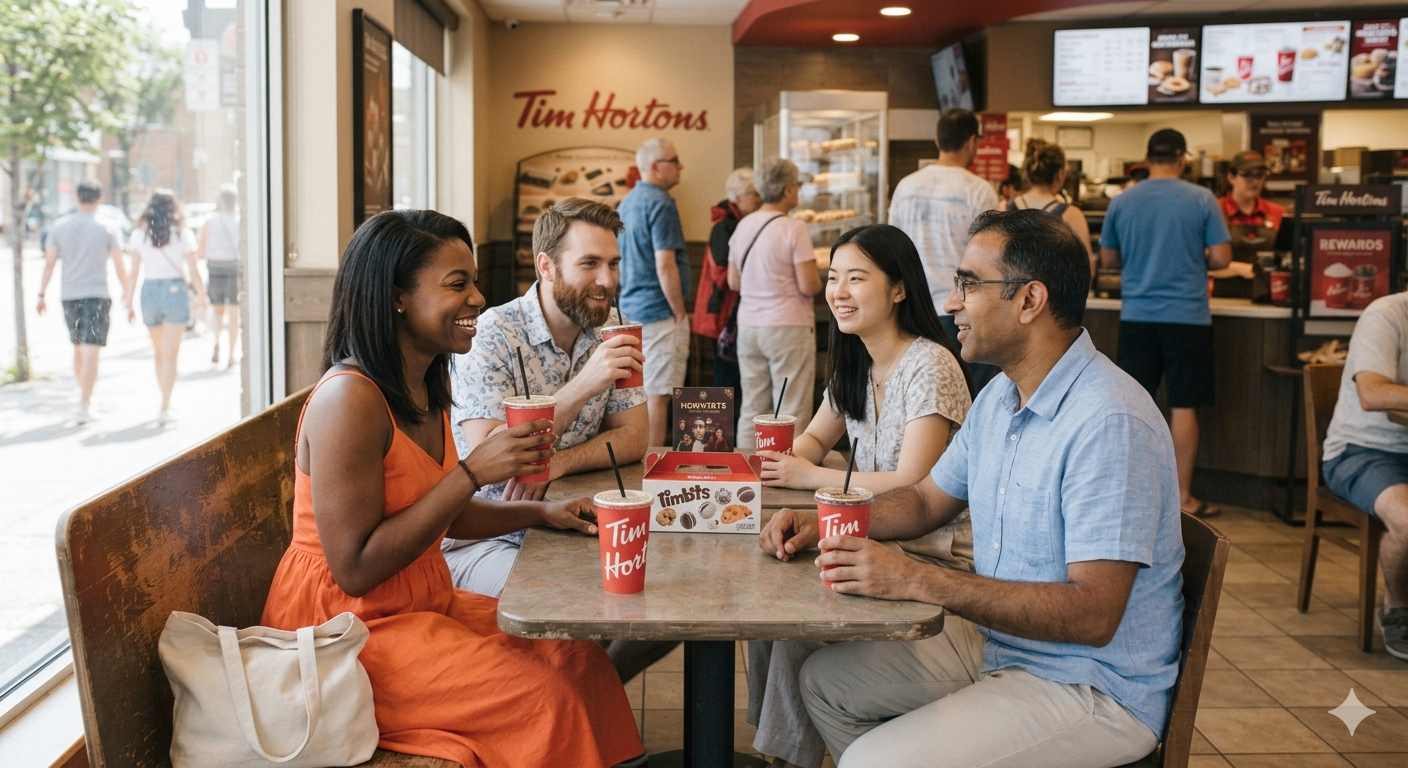


There was a time when the Canadian morning ritual was a simple, unadorned affair. You stood in a reliably long queue, shuffled your boots against the winter slush, and ordered a Double-Double. It was a cultural contract built on the premise of no-nonsense utility. But walking into a franchise today, you are no longer just a commuter seeking a caffeine jolt; you are a Muggle being aggressively sorted into a Hogwarts house.
The recent rollout of Tim Hortons’ "Back to Hogwarts" campaign—complete with Golden Snitch Timbits, house-themed baked goods, and a full-scale theatrical takeover of a downtown Toronto storefront—marks a fascinating, if slightly jarring, evolution in Canadian corporate strategy. It represents the complete sublimation of regional identity into globalized entertainment ecosystem mechanics.
For decades, the brand's marketing strategy was simple: wrap the product in the Maple Leaf, invoke the ghost of a hockey legend, and position the local drive-thru as the town square of a polite, industrious nation. It was a brilliant, albeit manufactured, mythos that transformed a fast-food chain into a pillar of national heritage. However, national myths require upkeep, and more importantly, they must appeal to a generation raised less on frozen backyard rinks and more on algorithmic monoculture.
By tethering its fortunes to a 25-year-old British fantasy franchise owned by an American media conglomerate, the company is admitting that Canadian nostalgia alone can no longer sustain growth. The modern consumer does not want a quiet reflection on northern perseverance with their morning cruller; they want an experience. They want nostalgia, yes, but a specific, weaponized brand of childhood nostalgia that crosses international borders.
This pivot to high-concept, intellectual-property-driven marketing is a masterclass in modern retail survival, but it exposes the hollow core of contemporary corporate "canadiana." When a brand that once defined itself by local authenticity relies on magical escapism to drive digital app engagement and sweepstakes entries, it signals a shift from community-building to sheer attention-economy optimization.
There is an undeniable commercial wizardry at play here. Linking the morning coffee run to collectible merchandise and interactive digital loyalty loops ensures that the brand remains culturally conversational. Yet, as the familiar brown-and-red paper cups are swapped for lightning bolts and wizarding crests, one cannot help but feel a twinge of cynicism.
We have reached a point where even our most stubbornly domestic institutions must seek validation from global mega-franchises to remain relevant. The magic, it seems, isn't in the coffee bean or the local community anymore—it is in the licensing agreement.
If you want, I can:
- Shift the focus to the economic impact of fast-food partnerships
- Make the tone more satirical or critical
- Explore how competitors use similar strategies
Let me know how you would like to adjust this piece.

Comments
There are 0 comments on this post